Get A Quote Today!
8
Oct 2026
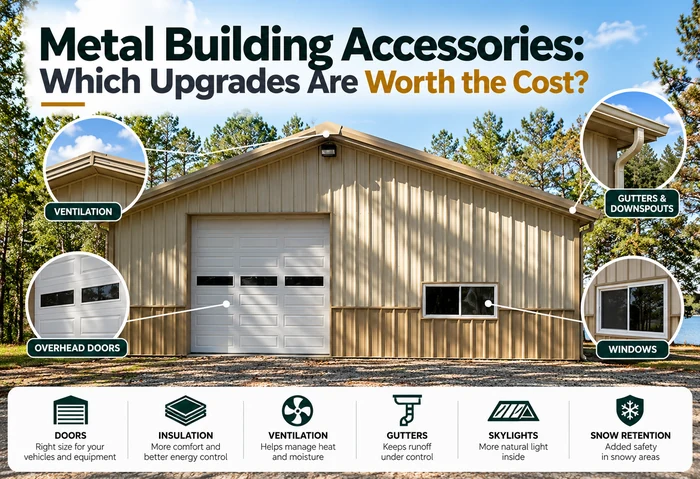
Metal Building Accessories: Which Upgrades Are Worth the Cost?
You’ve settled on the size of your steel building, checked the base price, and started reviewing optional upgrades. Now the quote is growing. Which metal building accessories deserve that extra money?
The upgrades most worth paying for solve an everyday problem, reduce a foreseeable risk, or prevent costly changes after construction. A contractor may value a properly sized overhead door more than decorative panels. A farmer storing equipment may prioritize moisture control. A heated workshop has different needs from a simple storage building.
At Safeway Steel, we help buyers decide where their accessory budget should go before the building is ordered.
Key takeaways
- Prioritize the access, ventilation, insulation, and drainage features your building actually needs.
- Choose structural openings and factory-applied roof products before fabrication.
- Powered doors are most useful where access is frequent.
- Windows, skylights, and decorative finishes depend on your use and budget.
- Compare full installed costs, including related framing, wiring, and labor.
For details on the product options, see our complete metal building accessories guide.
How do you know whether a metal building upgrade is worth paying for?
An accessory earns its place in the budget when its benefit makes sense against its complete installed cost. That benefit might be easier equipment access, moisture protection, better interior conditions, or more reliable everyday operations.
Will you use it regularly?
A powered overhead door can be helpful in a repair shop where vehicles arrive throughout the day. For storage opened only occasionally, a manual door may work just as well. Estimate how frequently the feature will be used before paying extra.
Does it solve a predictable problem?
Gutters can help direct runoff away from entrances and soil near a building. Condensation control may protect equipment in an unheated structure where interior moisture is a concern. Start with problems that your climate, site, and intended use make likely.
Will it be harder to add later?
Enlarging a door opening can involve new framing and exterior panel work. Factory-applied condensation products must be selected before the panels are manufactured. Installation timing changes the true cost of an accessory.
Can a simpler option meet the same need?
Standard doors may suit a project that does not require custom openings. Carefully placed electric lighting may be preferable to roof daylight panels in a workshop needing temperature control. Spend on the feature that meets the requirement, rather than assuming the most expensive option is the best.
Which upgrades offer the best practical value?
| Upgrade | Worth the cost when | Can be lower priority when |
|---|---|---|
| Larger overhead door | Equipment requires additional clearance | Standard opening fits current and anticipated needs |
| Insulation | The building will be heated, cooled, or regularly occupied | Unconditioned storage has no comparable thermal need |
| Condensation control | Moisture threatens stored items or use of the space | A suitable moisture-control approach already meets the need |
| Ventilation | Air exchange is needed for heat, humidity, or building operations | Existing systems satisfy applicable requirements |
| Gutters and downspouts | Roof runoff creates drainage or access problems | The site already has an adequate drainage solution |
| Powered door | Frequent operation makes convenience and speed useful | Access is infrequent |
| Windows or daylight panels | Natural light benefits regularly used space | Security, wall use, or thermal needs outweigh daylight benefits |
| Decorative trim or wainscoting | Appearance or lower-wall protection matters | It’s a basic utility or storage building |
These are practical comparisons, not guaranteed financial returns. Review product options on our steel building accessories page and our components page.
Where should your accessory budget go first?
For equipment storage: access and protection
Measure your largest piece of equipment, including attachments and operating clearance. Review the site for moisture and drainage concerns. For an occasionally used storage building, extra windows and powered doors may be less valuable than dependable access and weather protection.
For garages and workshops: work conditions
Start with door clearance and interior layout. Then plan ventilation, insulation, and any heating or cooling system together. Consider dust, fumes, heat, tools, and how long people will work inside. A shop used every day justifies different accessories from a garage used for seasonal storage.
See our garages and workshops for related building options.
For agricultural buildings: clearance and moisture management
Tractor storage, hay storage, livestock, and farm workshops have different requirements. Equipment clearance and ventilation may come before appearance upgrades. Livestock operations can need specialized airflow beyond ordinary storage ventilation.
Explore farm and agricultural buildings.
For commercial buildings: daily workflow
A badly placed loading door may slow material handling. Inadequate ventilation or insulation can affect the interior’s intended use. Review access, climate needs, drainage, and future machinery before optional exterior finishes. In customer-facing buildings, appropriate glazing and entrance details may carry additional value.
Review our commercial and industrial metal buildings.
Which metal building upgrades can you skip on a tight budget?
Powered doors on rarely used buildings
Motorization adds equipment and may require electrical work. Compare the fully installed cost with the number of times you actually open the door. A manual option may be sufficient for occasional-use storage.
Additional skylights without a daylighting need
Daylight can benefit regularly occupied buildings, but roof openings also require proper detailing and maintenance. If a building is mainly used for storage, determine how much daylight you really need before paying for added panels.
Decorative upgrades before functional requirements
Custom trim and wainscoting may be sensible for storefronts or walls exposed to everyday contact. Standard finishes may be enough for equipment storage. Keep optional finishes separate in the quote so their cost is easy to see.
Extra windows without an interior layout
Windows use wall space that may be needed for workbenches, shelving, or equipment. They also affect privacy, security, and the building envelope. Plan the room first and place windows where they support its use.
How much should you budget for accessories?
There is no single percentage that fits every steel building. A basic unheated barn and a conditioned workshop can have very different accessory needs. Group your spending into three priorities:
- Required or difficult-to-change features: necessary access, code-related features, insulation provisions, and structural or factory-applied components.
- Frequently useful improvements: powered doors, drainage additions, and daylighting that support everyday operations.
- Optional appearance and convenience items: specialty finishes and extras that have a lower immediate impact on the building’s intended use.
Ask each supplier for a complete installed price. A powered door may need electrical service and safety controls. A canopy may need structural support and foundations. An attractive product price can leave out substantial related work.
How should you compare quotes with different accessory packages?
Two quotes for similar building dimensions may include very different work. Check every allowance and exclusion before deciding.
| Quote item | What to verify |
|---|---|
| Doors | Opening size, insulation, operator, and related framing |
| Insulation | Materials, coverage, and expected performance |
| Ventilation | Components and adequacy for intended operations |
| Drainage | Gutters, downspouts, and water discharge |
| Exterior finishes | Standard and optional panel treatments |
| Installation | Labor, electrical work, flashing, and other exclusions |
Ask whether any accessory requires a change to the engineered design, whether installation is included, and what the warranty covers. Compare the final scope rather than the starting price.
Should you buy upgrades now or add them later?
The right time depends on how the accessory connects to the building. Structural openings, roof-mounted components, and factory-applied products usually deserve early planning.
For example, Dr!pStop condensation control is applied to roof panels during manufacturing. It is not the same as installing a full thermal insulation package later.
Some interior accessories can be added afterward, provided the building design supports them. Tell your building designer about planned future doors, canopies, equipment, or other changes so the initial design can account for them where appropriate.
Frequently asked questions
Which metal building accessories should I buy first?
Start with accessories needed for access, intended operations, safety, and weather protection. Properly sized doors, ventilation, insulation or condensation control, and drainage are common priorities. Your use and local climate determine the order.
Are more expensive steel building upgrades always better?
No. A powered door can be useful where vehicles enter frequently, while a manual door may suit occasional-use storage. Judge each option by the problem it solves and its complete installed cost.
Which upgrades are most difficult to add after construction?
Large structural openings, some roof changes, and factory-applied condensation products are among the upgrades that require early decisions. Retrofitting can involve framing, panels, labor, and weatherproofing. Review anticipated needs before fabrication.
Are insulated overhead doors worth the cost?
They can make sense for conditioned buildings when the door is part of the thermal envelope. Results depend on the complete door assembly, sealing, and use. A standard door may be enough for unconditioned storage.
Can I save money by adding accessories later?
Sometimes, but later installation can add labor or rebuilding costs. Decide structural, factory-applied, and difficult-to-access components during design. Defer optional items only after checking that they can be added safely and economically.
Do metal buildings need gutters?
Gutters are useful where uncontrolled roof runoff creates erosion, standing water, or access problems. They should be considered with grading and drainage design. Your site and local rainfall help determine the right solution.
Build around what matters most
A good accessory budget starts with how you will use the building. Storage projects may prioritize access and weather protection; workshops may need better ventilation, insulation, and daily convenience. Commercial facilities may require more specialized systems.
Safeway Steel supplies Made-in-USA steel buildings with custom design support and more than 20 years of industry experience. Our team can help you compare practical accessory options before you finalize the project.
Get a Free Steel Building Quote or call 800-818-2245 to speak with a Safeway Steel building expert.